


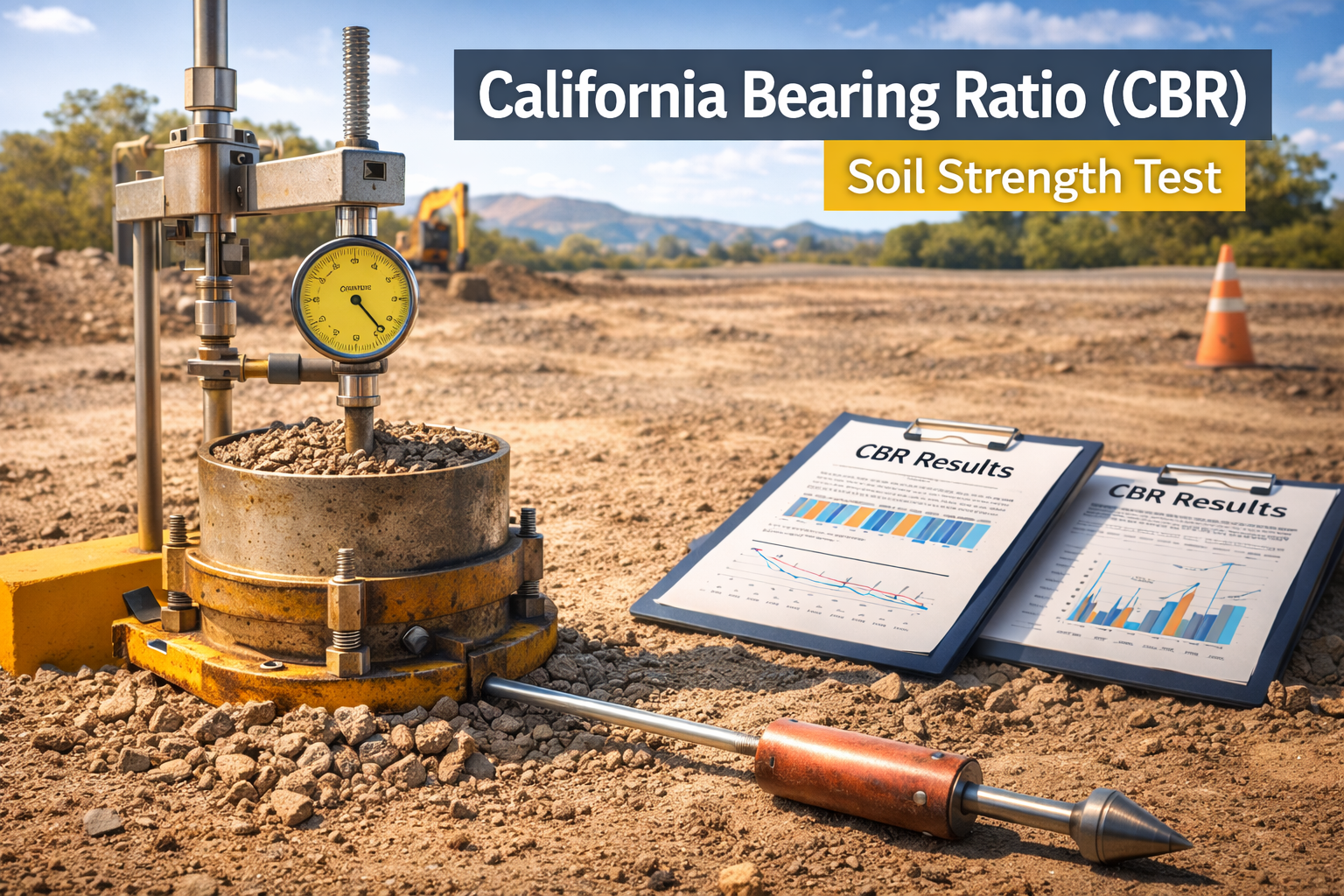
Understanding the California Bearing Ratio in Geotechnical Engineering
When engineers design modern roads and highways, ensuring a stable foundation is the most critical step. Pavement design relies heavily on evaluating the underlying ground to prevent structural failure under heavy traffic loads. The primary method used to assess this foundational stability is the California bearing ratio test.
The California Bearing Ratio (CBR) is a penetration test. It measures the strength of natural ground, subgrades, and base courses under new roads. By comparing a material’s bearing capacity to standard crushed stone, the CBR measures soil strength. It helps determine pavement thickness.
This test remains a cornerstone in civil engineering and road construction throughout the United States. Engineers need accurate test results.
They use these results to improve how they use materials.
They also use them to reduce costs.
This helps them build infrastructure that lasts for decades of traffic.
Table of contents
- Understanding the California Bearing Ratio in Geotechnical Engineering
- What Is the California Bearing Ratio (CBR)?
- History and Development of the California Bearing Ratio Test
- How the California Bearing Ratio Test Works
- Field California Bearing Ratio CBR Test vs Laboratory Test
- Factors Affecting California Bearing Ratio CBR Results
- Applications in Road and Pavement Design
- Alternative Soil Testing Methods
- Frequently Asked Questions
- Conclusion
What Is the California Bearing Ratio (CBR)?
The California bearing ratio (CBR) is an empirical index. It measures the bearing capacity of subgrade soils, subbase, and base course materials. In simple terms, it provides a standardized way to express how much load a specific soil can handle before yielding.
What the cbr measures is the resistance of a material to penetration by a standard-sized cylindrical plunger. This resistance is shown as a percentage.
It is compared to the reference resistance of high-quality standard crushed limestone.
A material with a CBR of 100% offers the same resistance to penetration as the standard crushed stone reference. Conversely, weaker soils will yield much lower percentages. This direct comparison allows geotechnical engineers to classify soil strength uniformly across different project sites and environments.
History and Development of the California Bearing Ratio Test
This testing method dates back to the 1920s, long before modern interstate systems existed. It was originally developed by the california division of highways to standardize the design of flexible pavements.
Before this development, engineers lacked a uniform method to correlate soil strength with pavement thickness requirements. The introduction of this testing protocol revolutionized highway engineering, allowing for data-driven construction practices across the United States.
Today, the methodology remains largely unchanged, though testing equipment has modernized. Whether evaluating rural highways or managing major construction planning in Orange County, California, civil engineers continue to rely on these foundational geotechnical principles. The Federal Highway Administration still extensively references CBR methodologies in their modern pavement design guidelines.
How the California Bearing Ratio Test Works
Executing the test requires strict adherence to standardized procedures to ensure repeatability and accuracy. The process is typically conducted in a controlled laboratory environment using disturbed or undisturbed soil samples collected from the project site.
The core of the procedure involves using a specialized machine equipped with a precise loading frame. This apparatus applies downward pressure on a standardized steel plunger to penetrate the soil sample at a strictly controlled pace.
Sample preparation
Proper preparation of the material is critical for obtaining valid data. The soil is usually compacted into a cylindrical mold to match the expected field density. In some cases, the sample incorporates crushed rock to simulate actual base course mixtures.
The prepared mold is often soaked in water for 96 hours to simulate the most adverse, fully saturated conditions the soil might face in the field. Swell is also measured during this soaking period to gauge the material’s expansive potential.
Penetration test at 1.25 mm per minute
Once the sample is ready, it is placed under the loading frame. The cylindrical plunger is seated on the surface, and a minimal seating load is applied to ensure full contact.
The machine then forces the plunger to penetrate the soil sample at a uniform, specified rate of 1.25 mm min (or 0.05 inches per minute). Maintaining this exact speed is crucial, as variations can skew the force readings and invalidate the trial.
Recording test results
As the plunger descends, the load required to achieve specific penetration depths—typically 2.5 mm and 5.0 mm—is carefully recorded. These test results are then plotted on a load-penetration curve.
The load readings are divided by the standard load values for high-quality crushed stone at the corresponding penetration depths. The resulting ratio, multiplied by 100, gives the final CBR percentage used for structural engineering calculations.
Field California Bearing Ratio CBR Test vs Laboratory Test
While laboratory testing is the industry standard, engineers sometimes require immediate, in-place data. The field CBR test is done on the ground at the construction site. It checks the soil in its natural, undisturbed state.
The field test uses mobile heavy equipment, such as a loaded truck, to provide the reaction weight for the loading frame. While convenient, the field bearing ratio test CBR cannot match the worst-case soaked conditions from lab samples.
Therefore, field tests are primarily used for rapid quality control during construction. They help verify that freshly compacted subgrades meet the design specifications previously established by comprehensive laboratory evaluations.
Factors Affecting California Bearing Ratio CBR Results
Several environmental and physical variables can dramatically alter the structural capacity of a material. Understanding these variables helps engineers interpret the data accurately.
Soil types
Different soil types inherently possess different load-bearing capabilities. Cohesionless materials like gravel and sand generally yield high CBR values. Conversely, fine-grained soils like clay and silt tend to have much lower values. They are also highly prone to deformation under stress.
Moisture content
Water is arguably the most significant factor affecting geotechnical stability. The moisture content of the sample at the time of testing directly dictates its strength. High moisture levels lubricate soil particles, reducing friction and drastically lowering the overall load-bearing capacity.
Compaction level
The density achieved during site preparation also plays a vital role. Higher compaction increases the interlocking of soil particles, leading to higher cbr results. Poorly compacted subgrades will inevitably fail prematurely, highlighting the importance of proper rolling and grading on site.
Applications in Road and Pavement Design
The primary application of this engineering metric is determining the necessary thickness of flexible pavements. A subgrade with low bearing capacity needs a much thicker base course and asphalt layer.
This helps spread traffic loads safely over a wider area.
Guidelines published by professional organizations like the American Society of Civil Engineers rely heavily on these metrics for infrastructure planning. By using accurate field data to design pavements, engineers prevent rutting and cracking, and avoid roadway failure.
Alternative Soil Testing Methods
While the traditional penetration approach is ubiquitous, civil engineering encompasses several other geotechnical test methods. One popular alternative for rapid, in-situ evaluation is the dynamic cone penetrometer (DCP).
The dynamic cone penetrometer uses a sliding hammer to drive a metal cone into the ground. It measures how far the cone penetrates with each blow.
These readings can be linked to CBR values using measured data. This gives engineers a fast, low-cost way to assess large subgrade areas. It avoids setting up a static field loading frame.
Frequently Asked Questions
What does the California Bearing Ratio measure?
It measures the mechanical strength and load-bearing capacity of subgrades and base courses. It compares the penetration resistance of the tested material against a benchmark of high-quality standard crushed stone.
Why is the CBR test important in road construction?
The cbr test is important because it provides the critical data needed to design safe, long-lasting pavements. Knowing the subgrade strength prevents over-engineering, which wastes money, or under-engineering, which leads to rapid road failure.
What is a good CBR value for pavement design?
Values range widely depending on the material. A value of 2% to 5% is common for natural clay subgrades. High-quality crushed rock base courses often exceed 80%. Generally, a subgrade value of 10% or higher is considered excellent for supporting road construction.
How is the field CBR test performed?
It is performed by placing a loading jack and plunger directly on the prepared ground site. Heavy construction equipment acts as the counterweight.
The plunger is pushed into the ground to measure in-place resistance in real time.
Conclusion
The California bearing ratio (CBR) test is important in modern civil engineering. It also plays a key role in building infrastructure in the United States. Since its inception, it has provided a highly reliable, standardized metric for assessing challenging subsurface conditions.
By accurately quantifying soil strength, engineers can optimize pavement designs to ensure durability and safety under constant traffic loads. Understanding these tests helps construction professionals build strong, lasting roads. These roads support modern transportation networks.


 test measures soil strength for road and pavement design. Learn how the CBR test works, what affects)