


A comprehensive Guide to California Core Content Standards
Understanding the educational frameworks that guide student learning is essential for everyone involved in a child’s academic journey. The California core content standards serve as the foundational blueprint for public education across the state.
These standards shape what students should learn. They guide the knowledge and skills needed to succeed today. They provide a unified, consistent educational target for schools from San Diego to Sacramento.
By setting clear expectations, these standards are incredibly important for students, teachers, and parents. They ensure that all children, regardless of their zip code, receive a high-quality education that prepares them for the future.
Table of contents
- A comprehensive Guide to California Core Content Standards
- What Are California Core Content Standards
- Subjects Covered by California Standards
- Structure Across Grade Levels
- Connection to College and Career Readiness
- How Teachers Use Content Standards
- What Parents and Guardians Should Know
- Differences Between California Standards and Common Core
- Benefits and Challenges of the Standards
- Frequently Asked Questions
- Conclusion
What are California core content standards?
California core content standards are rigorous educational guidelines that define the knowledge and skills students should master at each grade level. Adopted by the state, they ensure consistent, high-quality learning expectations across various subjects to successfully prepare students for future academic and professional endeavors.
What Are California Core Content Standards
At their most fundamental level, content standards are not a curriculum. They make sure all children, no matter their zip code, get a high-quality education for the future.
Instead, the curriculum targets these specific learning goals.
They outline exactly what a student should know and be able to do at the end of each school year. This ensures a consistent educational baseline across the entire California state school system.
These state-specific benchmarks are deeply connected to the broader national framework known as the common core state standards. California adopted these national benchmarks and carefully modified them to meet the unique needs of its diverse student population.
Subjects Covered by California Standards
The educational framework in California covers a wide variety of subjects to ensure a well-rounded academic experience. A primary focus is placed on english language arts literacy.
This literacy component emphasizes critical reading, evidence-based writing, and effective communication skills. Mathematics is the other major pillar, focusing on deep conceptual understanding and practical problem-solving over rote memorization.
Beyond these foundational subjects, California has established rigorous standards for science, history-social science, physical education, and the visual and performing arts.
Maintaining a balanced curriculum across all these subjects is crucial. It ensures that students develop both the analytical skills and the creative thinking necessary for holistic intellectual growth.
Structure Across Grade Levels
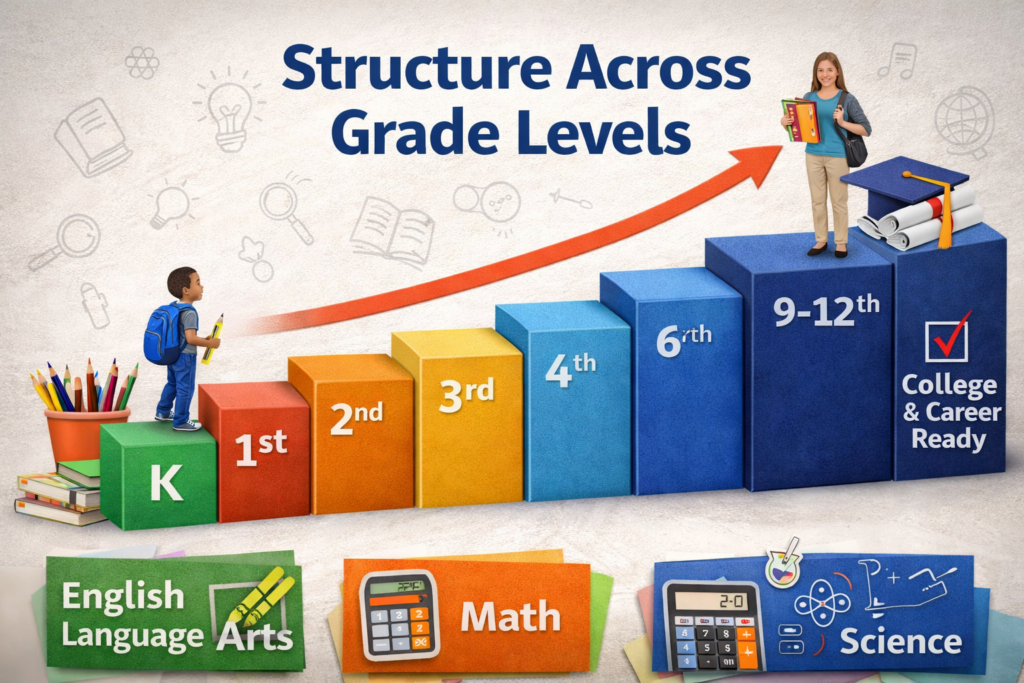
The standards are meticulously designed to support a seamless kindergarten through grade twelve educational journey. They are structured as a staircase of increasing complexity.
Each year, the concepts taught build directly upon the foundations laid in the previous year. This deliberate design prevents gaps in learning and minimizes unnecessary repetition.
As students experience this progression through the grade levels, the expectations become more sophisticated. A first grader learning to add single digits is building the necessary groundwork for the algebra they will encounter in middle school.
Connection to College and Career Readiness
The ultimate goal of the state’s educational framework is to prepare students for life after high school. Every standard is reverse-engineered from the demands of the modern workforce and higher education.
Whether a student chooses a university path or enters a vocational trade, they need strong analytical and communication skills. The standards focus heavily on college and career readiness.
This means teaching students how to analyze complex texts, defend arguments with evidence, and solve real-world mathematical problems. These are the exact skills required for college and career success in the twenty-first century.
How Teachers Use Content Standards
For educators, these standards act as an essential compass. They guide daily lesson planning and long-term instructional strategies.
While the state dictates the what through the standards, teachers and local school districts determine the how. Educators use their professional expertise to choose the best teaching methods, books, and classroom activities to help students reach these goals.
Standards also form the basis for classroom assessments and statewide testing. By evaluating students against these consistent benchmarks, teachers can identify who needs additional help and who is ready for advanced challenges.
What Parents and Guardians Should Know
The role of the parent guardian is critical in helping students achieve academic success. Understanding the standards empowers families to advocate for their children effectively.
Parents can support their children at home by knowing what skills are expected for their current grade level. This allows for more targeted help with homework and more productive conversations during parent-teacher conferences.
Families can easily review the full details of these academic expectations by visiting the official California Department of Education web page.
For families planning long-term educational goals, broader household stability often goes hand-in-hand with academic success. Parents balancing educational support with household management might sometimes explore local financial resources, such as options for credit repair in Orange County, California, to ensure a strong foundation for future college expenses.

Differences Between California Standards and Common Core
While California’s educational goals are heavily based on the national framework, they are not identical. There are significant similarities, particularly in the core subjects of math and language arts.
Both frameworks emphasize critical thinking over memorization and require students to explain their reasoning. However, there are key differences that reflect the specific priorities of the state.
When California adopted the national guidelines, it added specific California-specific adaptations. The state included additional standards, sometimes referred to as the “15 percent addition,” to maintain the rigor of its previous, highly regarded state standards, particularly in advanced mathematics.
To read the national baseline framework in its entirety, you can visit the Common Core State Standards Initiative website. For the specific adaptations, the California Department of Education provides comprehensive documentation.
Benefits and Challenges of the Standards
The implementation of these rigorous academic goals brings several distinct advantages. The primary benefit is consistency; a student moving from San Francisco to Los Angeles will face the same academic expectations.
They also promote a deeper understanding of material, moving away from teaching to the test. Students are encouraged to develop genuine problem-solving skills.
However, the framework is not without criticism. Some educators and parents express concern over the high-stakes testing associated with measuring these standards.
Additionally, the transition periods when standards are updated can be challenging for both teachers adapting their lesson plans and students adjusting to new expectations. Continuous feedback and ongoing improvements are necessary to address these limitations.
Frequently Asked Questions
What are California core content standards?
They are a set of clear, rigorous educational expectations adopted by the state of California. They outline what students should know and be able to do in each subject at the end of every grade level.
Are they the same as Common Core?
They are heavily based on the national Common Core standards but include specific additions. California added roughly 15% more content to ensure the standards met the state’s historical demands for academic rigor.
How do standards affect students?
They dictate the learning goals students must achieve each year. This affects the textbooks they use, the types of questions they answer on tests, and the daily lessons their teachers plan.
Where can parents find official standards?
Parents and guardians can find comprehensive guides, subject breakdowns, and family resources on the official California Department of Education website.
What subjects are included?
While initially focused on English language arts and mathematics, California has adopted rigorous standards for all major subjects. This includes science, history, physical education, world languages, and the arts.
Conclusion
Understanding the California core content standards is a vital step for anyone invested in the state’s educational system. They are the structural foundation upon which student learning is built.
By providing clear, consistent, and rigorous goals, these standards ensure that students are progressively building the skills they need. From kindergarten basics to advanced high school concepts, the framework supports ongoing intellectual development.
Ultimately, these standards require the collaboration of dedicated teachers, hardworking students, and informed families. When parents and educators actively engage with these educational benchmarks, students are given the best possible chance to thrive in college, their careers, and beyond.


